University of Social Sciences and Humanities
MATESOL 2023A

Lesson plan
Description of class:
Level: B1+
Size: 24
Description of students: The learners are young adults aged between 18 and 20, currently majoring in business-related fields. Their English proficiency is at a B1+ level. They are able to communicate effectively using both simple and complex structures, with a rich vocabulary related to business topics. The students are active, enthusiastic, and highly engaged in learning activities. They show a clear preference for task-based and game-based learning approaches.
Time: 3 periods. Each period lasts 45 minutes.
Teaching aids:
Textbook: Dubicka, I., O’Keeffe, M., Dignen, B., Hogan, B., & Wright, J. (2018). Business Partner B1+ (1st ed.). Pearson Education Limited.
Publication: Pearson Education Limited
Units: Unit 3-Lesson 5, Unit 4-Lesson 1
Facilities: The classroom is equipped with a modern projector, a whiteboard, markers, a computer, and air-conditioners. The seating settings are suitable for working individually, in pairs, and in groups.
Aims: The aims of each part are to
Objectives: By the end of the lesson, students are expected to be able to
Methodology:
Methods: Communicative Language Teaching/ Task-based Language Teaching
As learners are young adults majoring in business-related fields, Task-based language teaching (TBLT) is chosen for the lesson to match their preference for authentic, task-driven learning. In the lesson, tasks, such as writing covering letters, listening completion tasks, and vocabulary tasks, allow learners to demonstrate their English competence in real-life communicative tasks. TBLT is selected by teachers because teachers can recognize what students are able to do with language (express ideas,...) through concrete learning objectives in the form of tasks. Communicative Language Teaching (CLT) is also selected in order to motivate students to use English during the class. Students are encouraged to actively engage in the authentic use of language for meaningful purposes through the activities including assessment and project.
Procedure:
APPENDIX
UNIT 3
LESSON 3.5: WRITING A COVERING LETTER
ANSWER KEY FOR UNIT 3
Lead-in: Expected answers: working experience, careful study of JD and the company, job application form, CV (resumé), portfolios, health check certificate, degrees/certificates, 3*4/4*6 photos, a covering/cover letter, photocopy of ID…
Activity 1. T’s questions on the job advert:
1. What job position is being advertised in the post?
2. What qualifications are needed for the job?
3. What personalities/ characteristics of the candidate are required?
4. How long is the position for?
5. Is previous experience required?
6. If one would like to apply for the position, what will she send to the Head of Recruitment?
Activity 1. Expected answers:
1. Sales Interns.
2. A degree in business studies or sports education.
3. Highly motivated, organised, communicative.
4. 3-6 months.
5. No previous experience required.
6. A CV and a covering letter.
Nine mistakes and corrections in Activity 2:
Para 2:
1. degrees → degree (singular noun)
2. interntional → international (spelling)
3. experience → experienced (adjective needed)
4. we have won → we won (definite past time – last year)
Para 3:
5. spent last three → spent the last three (missing article)
6. helped me to increasing → helped me to increase (infinitive needed)
7. significant → significantly (adverb needed as describes the verb increase
8. would be suitable → would be a suitable (missing article)
Para 5:
9. look forward to hear → look forward to hearing (-ing form needed)
The cover letter format - A cover letter should be formatted with these sections:
- Salutation or greeting
- Opening paragraph (Para 1): State the purpose of the letter (applying for the job)
- Middle paragraph(s):
+ Paragraphs 2: Introduce relevant experience and qualifications
+ Paragraph 3: Explain motivation, enthusiasm, and fit for the role
- Closing paragraph: Polite closing and offer for interview/contact
- Letter ending and signature
Task 2 (p.36)
Paragraph 1
Please find my CV (1) enclosed. I'm writing to apply for the (2) vacancy of manager as (3) advertised in The Times. I'd like to be (4) considered for the post of manager.
Paragraph 2
I (5) have been working as a manager for 10 years.I have a(n) (6) degree in maths. I have six years' (7) experience in sales. I have proved to be a capable manager often (8) exceeding performance targets set.
Paragraph 3
I am (9) confident (that) my skills will make me a strong salesperson.
My skills will (10) allow me to … I feel (that) my experience will be a valuable (11) asset to your company.
Paragraph 4
I would be (12) grateful to have the opportunity of an interview. I would very much appreciate the opportunity of an interview.
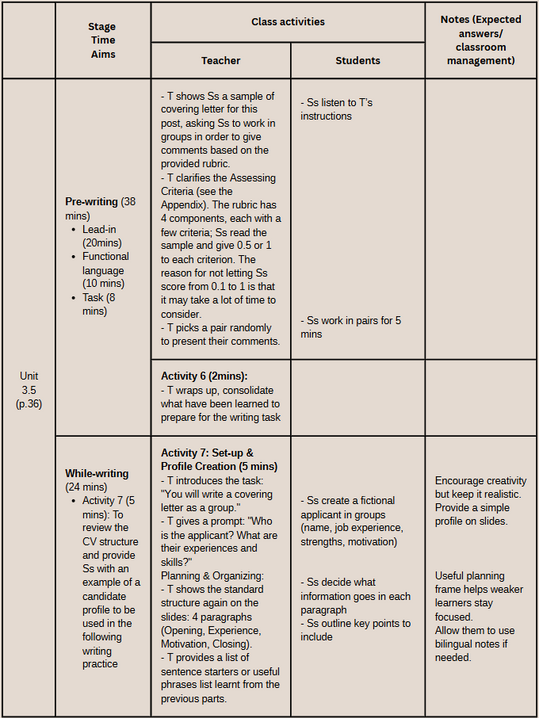
ASSESSING CRITERIA
Organization/layout
-
The letter has 4 main paragraphs.
-
Each paragraph communicates a clear function.
-
The letter has greeting, ending and signature.
Grammar/spelling
-
The letter has a few to zero spelling mistakes.
-
The letter has a few to zero grammar errors.
-
The letter has a few to zero punctuation errors.
-
The letter has a few to zero structure-related errors.
Word use/ content
-
The author uses words and phrases correctly.
Formality
-
The author writes with formal language (no spoken language, no contractions (don’t, didn’t).
-
The opening and closing of the letter are formally written.
B. Collocations& Word forms
B.1. The “Climb the career ladder” game
B.2. Suggested explanations/ examples:
Major player: a company, organization, or individual that has a significant presence and influence within a particular industry or area of activity
Example: Masan is one of the major players in the F&B industry.
Profit margin = (revenue - cost)/revenue
Example: Our new product recorded a high profit margin last year.
Emerging markets: countries with rapidly growing economies. These countries often have high growth potential.
Example: Vietnam, Thailand, and the Philippines are emerging markets in South East Asia.
Takeover bid: an attempt by one company to gain control of another company by buying its shares
Example: GM is receiving a takeover bid from its rival.
Product lines: a group of related products that a company sells.
Example: Apple's iPad is a very successful product line.
B.3. Answers for Activity 15
Task 7:
1. acquisition
2. compete
3. competitive
4. development
5. developed
6. expand
7. expanding
8. fail
9. growth
10. innovation
11. innovative
12. merge
13. performance
14. profit
15. risky
16. success
17. successful
18. take over
Task 8:
1. competition
2. competitive
3. growing
4. growth
5. successful
6. succeed